


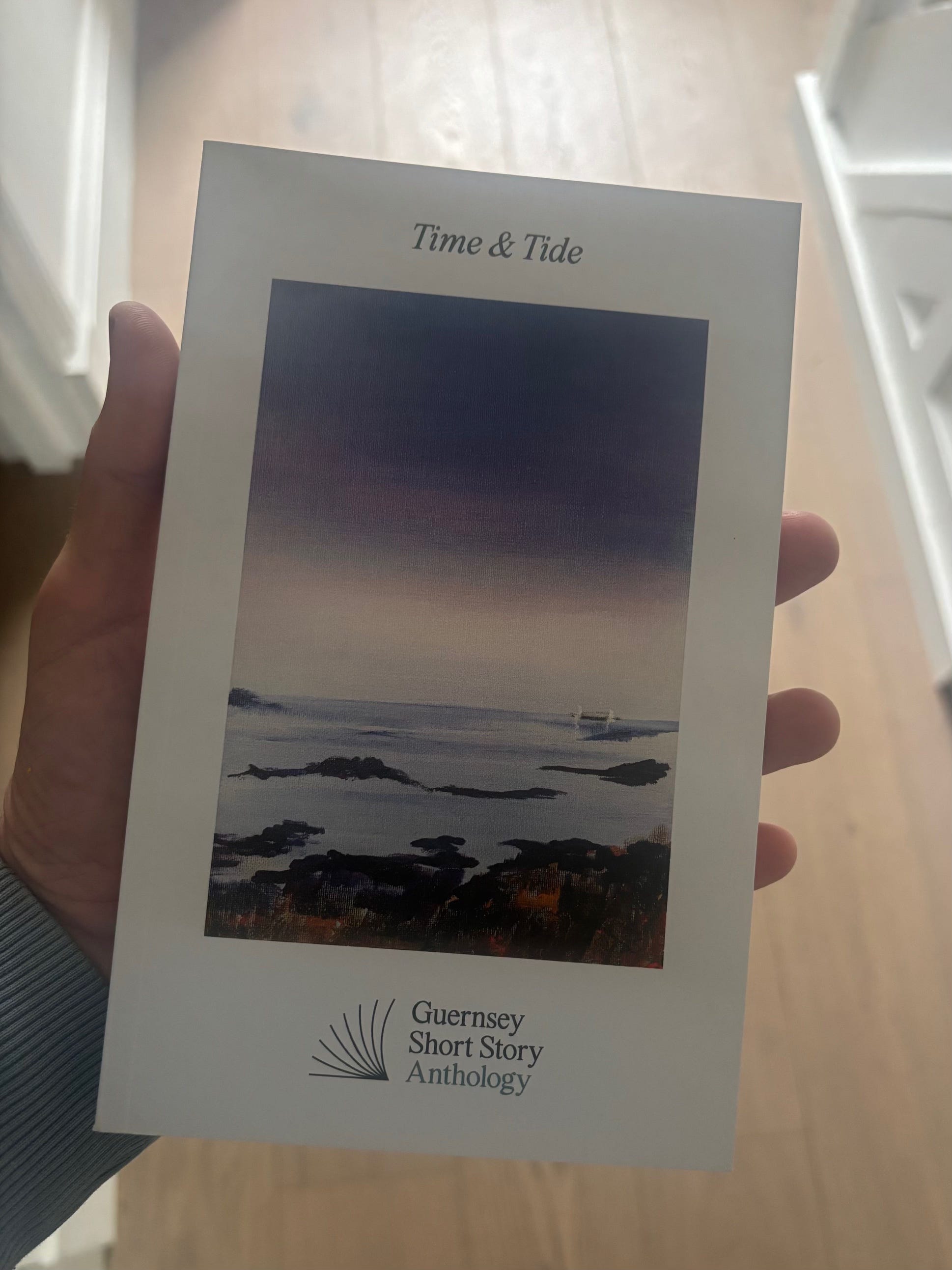
Pleased to be able to share L’Ancresse: a short story I wrote about grief and mortality for Time & Tide, the inaugural Guernsey Short Story Anthology.
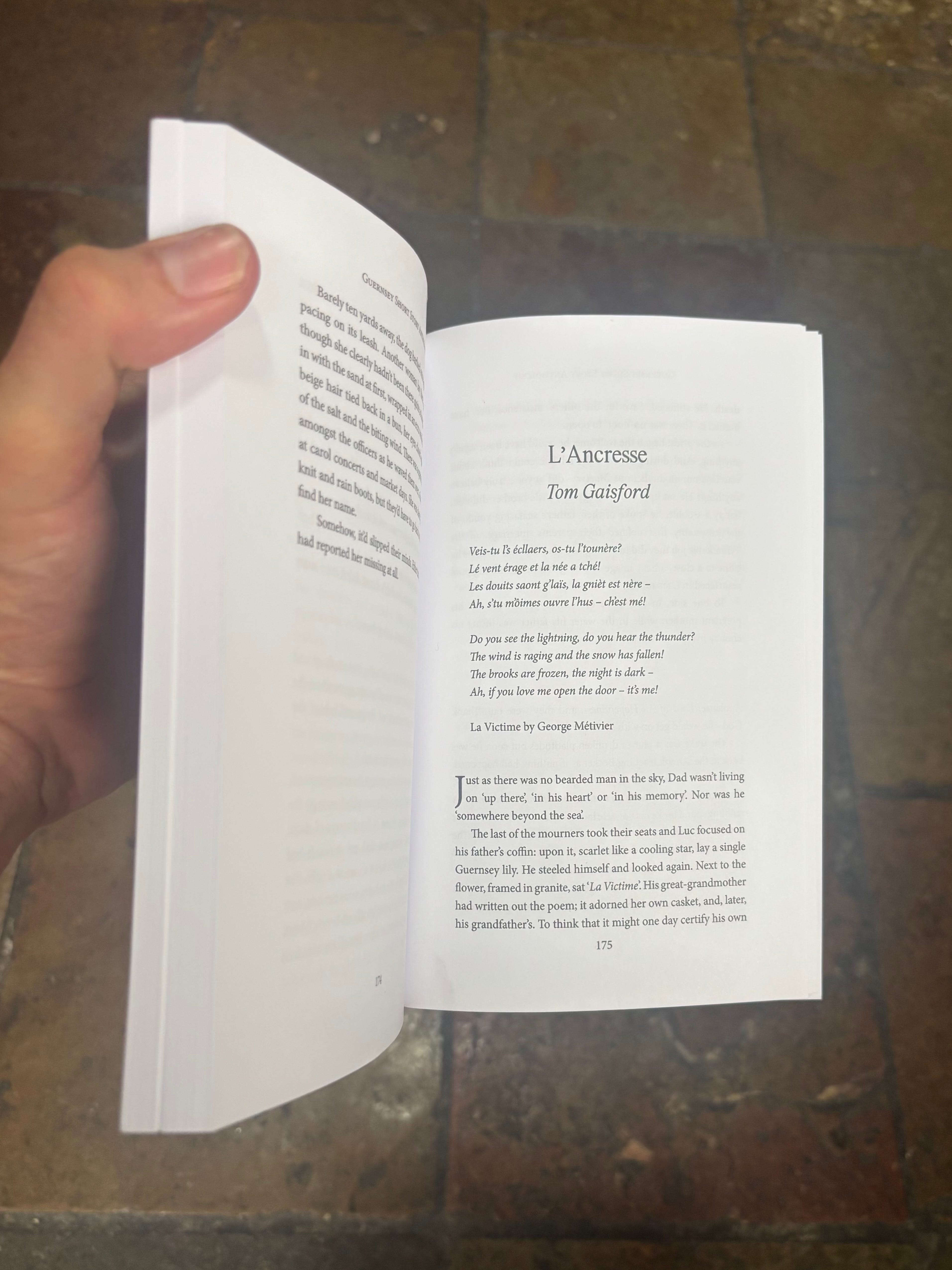
L’Ancresse
Tom Gaisford
Veis-tu l’s écllaers, os-tu l’tounère?
Lé vent érage et la née a tché!
Les douits saont g’laïs, la gnièt est nère –
Ah, s’tu m’ôimes ouvre l’hus – ch’est mé!
Do you see the lightning, do you hear the thunder?
The wind is raging and the snow has fallen!
The brooks are frozen, the night is dark –
Ah, if you love me open the door – it’s me!
La Victime by George Métivier
Just as there was no bearded man in the sky, Dad wasn’t living on ‘up there’, ‘in his heart’ or ‘in his memory’. Nor was he ‘somewhere beyond the sea’.
The last of the mourners took their seats and Luc focused on his father’s coffin: upon it, scarlet like a cooling star, lay a single Guernsey lily. He steeled himself and looked again. Next to the flower, framed in granite, sat ‘La Victime’. His great-grandmother had written out the poem; it adorned her own casket, and, later, his grandfather’s. To think that it might one day certify his own death. He stiffened. Save for the others’ insistence, he’d have binned it. There was no ‘door’ to open.
As the priest began the welcome, he could have been saying anything. And during the homily, all Luc could think about was Unamuno’s duplicitous Martyr - did anyone truly believe anything? He sat up for the eulogy. His little brother did well, barely a wobble; he spoke of their father’s seafaring youth, of the hospitality that defined their parents’ marriage, of the ‘remarkable job they did in raising two such flawless sons’. As he came to a close, a hazy image of a neighbour’s swimming pool resurfaced in Luc’s mind…
To one side, in the shade of some cypress trees, sat his pregnant mother, while in the water his father was lifting his chubby five-year-old self onto his broad back...
Applause, Lord of All Hopefulness, and they were out. Thank god - he would get on with his life now.
The wake was a blur of drunken platitudes but soon he was back at the school, teaching Becket as if nothing had happened. It was the last class of the day. ‘They give birth astride of a grave,’ he recited, ‘the light gleams an instant, then it’s night once more’. A sniffling sound broke his flow. He looked up and clocked a student at the back, tears streaming down her face. ‘Agnès, are you…’ The girl jerked her desk forward and fled the room. He caught up and tried to console her, but this only seemed to make it worse.
Mercifully, Headteacher Le Page intervened. Ushering Agnès into his office, he turned back to Luc. ‘Just lost her grandma,’ he whispered.
‘So she said.’ Luc dropped his head and left.
Walking home, he felt a mixture of remorse and resentment. Beastly for anyone to lose a loved one. But did she have to react like that? She was an adult, or as good as – she should try losing a… He stopped himself. ‘Victimhood is the ugliest of vices,’ his father would say. He choked on the memory: if only he were alive to say it! Who would listen to his own anxious grievances now? Who could ever possess such power to take him out of himself – to remind him that…that what? That it was all OK?
His mother might. He kicked a pebble into the gutter and carried on down the slope past Les Cotils to the sea. He tried to imagine how she would be feeling now, and dismissed the thought: as her own end drew nearer, the last thing she needed was doubt. Cathy then? But how much more could his gentle wife take? She had loved his father like her own. And there was her work, the endless stream of sickness and sadness flowing in and out of the hospice; she’d be low enough without him dragging her down further. He clenched his fists. He wanted to yell. But at whom? At life? At God?
‘You die alone,’ his father told him. And so it was, barely three weeks past, the memory still warm. A heart attack in Havelet Bay. Harpoon of pain, floundering, gasping, then blue-cold silence.
When Luc reached Salerie Corner, the last of the light had disappeared and the sea was laid out flat, shrouded in black; the lights of Herm island were low-lying stars yet to succumb to omnipotent creeping darkness.
He opened the front door to find Cathy, on the phone. ‘Hang on’ – she passed him the receiver.
‘Mr. Le Page’.
‘Just got off the telephone to Agnès’s parents. They’re livid. Did - did you really tell the girl she’d never see her grandmother again?’
Heart pounding, he pictured Agnès’s tearful eyes and shut his own. ‘I told her the truth,’ he replied.
Thirty seconds later, Luc stared blankly at the phone a moment, then back at his wife.
‘He’s suspended me.’
‘Oh, darling.’ Tenderly, she stroked his cheek and for a fleeting moment all was quiet. Too quiet.
‘Marie?’ He looked around for her.
‘The snug,’ Cathy replied.
He opened the door. Felt pens lay strewn across the floor, and scrawled on the wall was a portrait of a stick man in a bath or something.
‘Marie! What have you done?’
The child flinched, ran to the sofa and buried her head in a cushion.
‘Luc…’
‘I despair - we’ve told her a hundred times!’
Marie was howling now.
‘Naughty, naughty girl!’ He dropped to the floor and began gathering up the colours. ‘These’re going in the bin!’
‘Enough, I said!’ Cathy pushed past and put herself between Luc and the child. ‘Look at it!’
‘I see it!’
‘No you don’t!’ She was staring at him in disbelief. ‘The dinghy, Luc?’ She whisked the child into her arms and sped upstairs.
‘Cath,’ he pleaded, eyes welling up. ‘I didn’t…’
‘No, you didn’t!’ came the response. ‘You’ve spent all of ten minutes with her since - we loved him too, you know!’
‘Cathy, please!’
Nothing.
He made for the door.
In a corner of the Ship and Crown, he downed his ale, the frothy brown liquid entering his body with the steady determination of intravenous fluid. At the bar, loud lads caroused and cursed with crashing ignorance. Fake smiles, hypocrites, lost lambs fleeced in delusion, bleating banalities to conceal their fear.
‘What you looking at?’ one shouted.
The snarly face was unfamiliar. Luc put down his glass and stood up.
‘Come on then, you old bastard!’ the boy laughed. A friend pulled him back and whispered something in his ear, but he wriggled free. ‘Oh, I see…’ He grinned. ‘Diddums missing daddy?’
Luc stepped up and swung, barely connecting with the bloke’s face, then felt his own jaw jerk and his body fall backwards as the ceiling spun and dwindled, and disappeared.
When he opened his eyes, everyting was white. For a moment he feared the worst, then his throbbing jaw brought back the horror of the night. He tensed up. Fucking twat - he’d murder the little tyke.
‘Here we are.’ A nurse he recognised as a parent from Marie’s school appeared with painkillers. ‘Doctor’ll be round shortly.’ She paused. ‘And the police want a word.’ He made to sit up, but she put a gentle hand on his shoulder. ‘Rest now, Luc.’
His head sank back into the pillow and his mind returned to a moment all but forgotten…
A young boy, he had awoken in the night to see the back of a tall figure leaving his bedroom. Locked still he lay in that haunted childhood twilight between night and day, pulse racing, tongue tasting the bloody gap where once a tooth had been, until, at last, sleep took him. When he reopened his eyes it was light. He reached under his pillow to find a fifty-pence piece, and breathed. But the coin had lost its shine. What else did they lie to him about…
‘Luc?’ The nurse was back. ‘I have DC De Lisle here to see you.’
The detective wasted no time. On the barman’s testimony, Luc had swung first, and the criminal standard of proof was in the thug’s favour – he’d have little trouble proving self-defence. In better news, CID were not minded to charge Luc himself.
‘Young lad’s well known to us,’ he explained. ‘And, ahm, we’re aware of your extinguishing circumstances.’ For the first time in weeks, Luc felt the traces of a smile appear on his face.
One X-ray, two packets of codeine and a referral to Guernsey Mind later, and Luc was out.
‘Great you’re getting some help,’ Cathy said on the drive home.
‘Oh come off it, Cath. What’s some shrink going to tell me that Shakespeare can’t?’
She parked and let out a long sigh. ‘Dawn’s down with flu.’
‘I can do pick-up.’
‘No, I don’t think…’
‘Cath’ – he looked her in the eye – ‘I want to.’
By late morning, the sun hung high over the island. After school, he’d take his daughter up to L’Ancresse for a picnic – people always flocked to the West Coast, but for all its easy enchantment, it lacked the empty serenity of the north. He texted Cathy and dug out the beach bag. Most of the stuff was there from last time. He made a mental note to grab Marie’s arm-bands and checked the time. Eleven fifteen: his pupils would be sitting their first exam. Too late to help them now - he’d only have upset the sensitive souls anyway. What good was being a teacher – what good was any of it – if you couldn’t speak the truth?
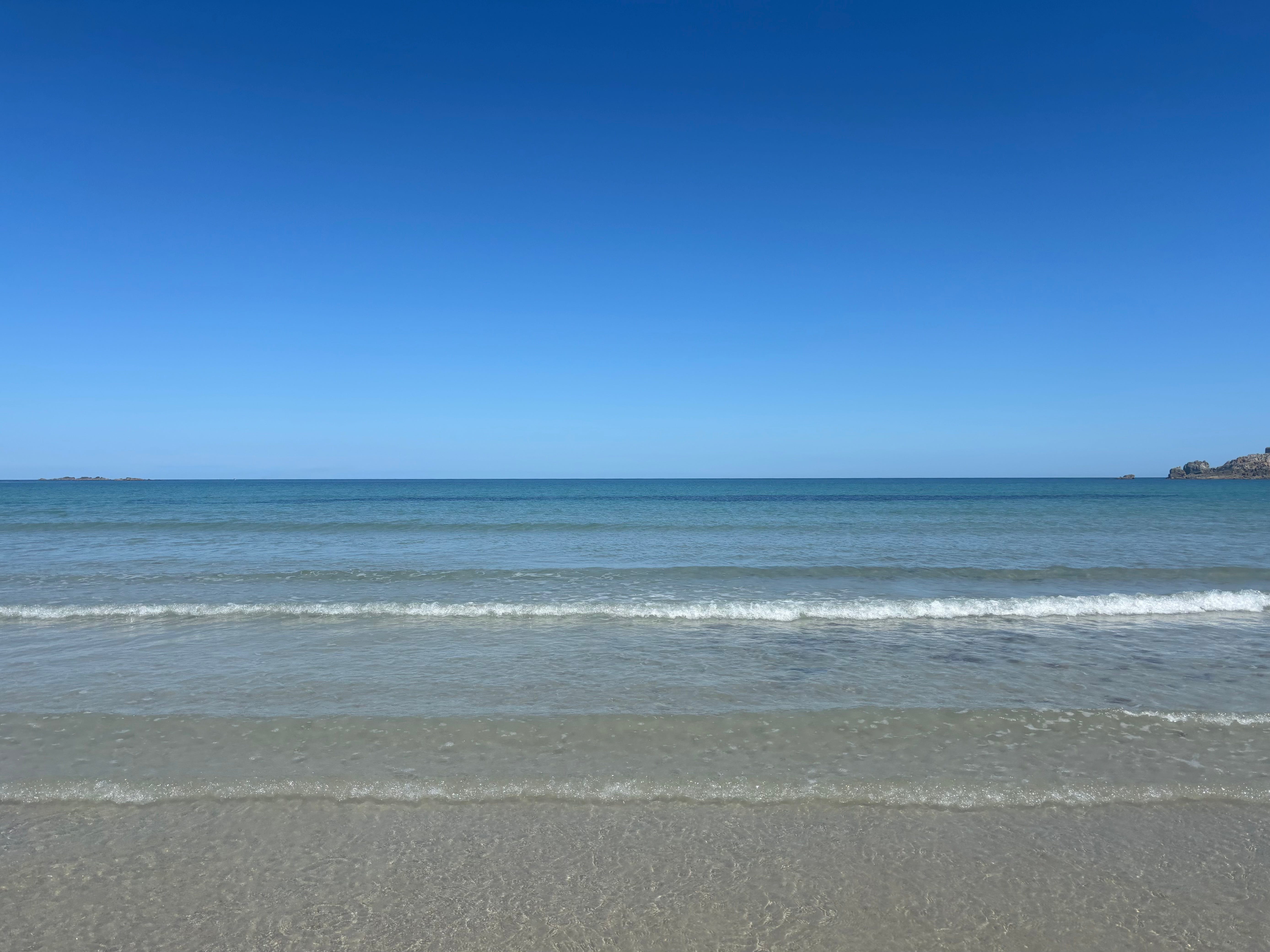
The beach at L’Ancresse was a watercolour brushed with glitter. Wide silver sands glistened under an immiscible horizon of aquamarine, cobalt and cloudless cerulean. Half way to the water, the floating pontoon lay lifeless, awaiting resuscitation from the incoming tide - and clambering all over it now, with shrieks of joy, was little Marie. Luc felt the corners of his mouth twitch. The fuss she’d made last year, when he refused to swim her out to it – but when it came to the sea he could barely vouch for his own safety. He sat on the sand, rocked back on his elbows and gazed out at the jagged peninsula on the eastern side of the beach. Squinting in the brightness, he could just make out a father and child hobbling over the rockpools, shrimping nets in hand.
Beyond the headland, the water swirled and darkened deep, a maelstrom of no return. He thought of the burning sensation they describe as your body resists the instinct to breathe, how his last conscious thought would be its infinite loss. In time, Marie would scarcely remember him. Cathy would be spared his despair.
He rolled onto his side and lay still for a while, broken like a shipwreck. Some noisy ravens cawed overhead and were gone. He shut his eyes and in the darkness found himself walking at his father’s side again, on the woodland trail around St. Saviour…
‘You scared?’ he asked peering up at his outline.
‘Of the dark?’ His father stopped and crouched down to Luc’s height. ‘Why would I be? You’re here.’
He flinched. Everyone was afraid of the dark…
He was roused by yelling. The shrimpers were running back along the headland towards him pointing. Marie! He shot to his feet and bolted to the sea, which had crept up like a silent assasin. Some ten, twenty metres away, the pontoon was afloat and sitting on it – thank god! – was the little one. But – CHRIST! – no armbands.
‘Wait there!’ he yelled, tearing into the water. Eyes trained on the rocking pontoon, he saw her stand up. ‘Down! Sit down!’ he cried. But she slipped and slid and splashed into the sea. Ten strokes, five seconds. He lost her a moment then saw an arm flailing above the waterline; a second later it’d gone again. He dived under the surface, shot forward and grabbed her with both hands, kicking hard against walls of water, once, twice, and breaking the surface apart like ice.
Air filled his lungs and Marie shrieked and yelped, her eyebrows near meeting her hairline. He rolled on his back like an otter, hugged her to his chest and with his free hand, tugged her to the pontoon. He made her grip the side, put a hand beneath her feet and launched her to safety, then hauled himself up.
Turning to the shore, holding her tight, he felt his whole being release and crack like a smile. Tears broke and fused with the salt in her tangled black hair.
‘Got her!’ he yelled.
‘What were you thinking!’ The onlooker shook his net at him incredulous, then turned and made for the slipway as a car pulled up. Cathy’s.
The door flew open.
‘Luc!’ she cried, dashing across the gravel, her white dress purling behind her like a wake.
‘She’s OK!’ he shouted back. She slowed to a stop and doubled over.
Luc peered down at the rippling seabed; he gauged the distance to the shore, then lowered himself into the water and whispered to her to climb onto his back.
Adrift, he spat and gasped for air, Cathy’s image listing from side to side behind splashes of bright white wavelets.
‘Not so tight,’ he choked.
Marie loosened her grip around his neck. He felt her heart thumping against his back, and his breathing deepened. The water was warm from the baked sand beneath; he slowed his outsweep, shut his eyes and saw cypress trees swaying in a soft summer breeze. When he reopened them, beneath the shimmering surface, his arms looked older, veinier, more weathered. Sharp intake of breath. Then the weightless calm of an embrace. The arms were his father’s.
‘Mummy!’ Back in the shallows, Marie slid off his back and ran to Cathy. Luc followed, knelt in the sand and flung his arms around them both.
‘You’re soaking!’ Cathy recoiled.
‘Cathy, I’m so…’ He got to his feet, she hesitated, then she held his head to her chest and he sobbed like a child.
When the tears ran dry, she released him and made for the car. ‘You going to help me with this picnic or what?’
The light softened and the tide receded, revealing new patterns in the sand. The little family made sandcastles and played at burying each other, then ate and drank, and talked about what happened, until the child sang herself to sleep in her mother’s arms, the soft tips of her outstretched fingers still warm from the setting sun.
So poetic and thought-provoking, thank you
I love this story so much!